By Mark Williams | Exterior Remodeling Expert
In my 20+ years in the residential exterior industry, I've watched homeowners pour tens of thousands of dollars into gorgeous siding and premium roofing, only to leave a crumbling, weed-infested asphalt driveway front and center. Your driveway is the literal red carpet to your home. As the largest horizontal surface on your property, it commands massive visual real estate. If it's failing, it instantly degrades the perceived value of your home, regardless of how beautiful your landscaping is.
When it comes time to rip out a failing driveway, I always see clients face the same heavy-construction dilemma. While basic asphalt is the cheapest option (averaging $3-$5 per square foot according to the National Asphalt Pavement Association), homeowners looking to elevate their curb appeal almost always narrow their choices down to two premium categories: Poured Concrete and Interlocking Pavers.
In this guide, I’m going to give you the unvarnished truth. We'll pit pavers against concrete in a brutal comparison of aesthetics, durability, maintenance requirements, and long-term costs based on what I actually see in the field, year after year.
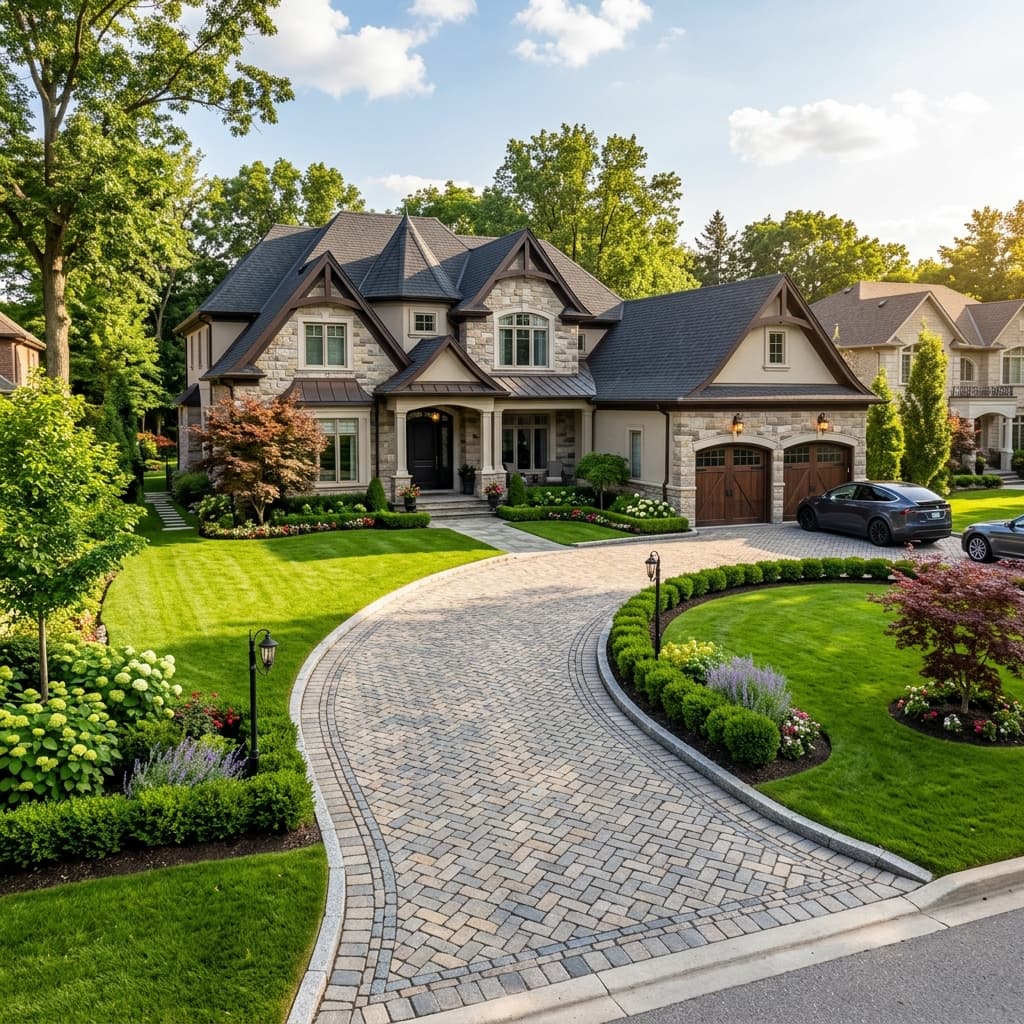 A custom interlocking paver driveway featuring a herringbone pattern and charcoal border. Notice how it elevates the overall aesthetic of the property compared to a flat gray slab.
1. The Reality of Installation
Before comparing performance, it's critical you understand how these two driveways are constructed. The installation method dictates exactly how and why they will eventually fail.
Poured Concrete: The Monolithic Slab
A standard concrete driveway is a monolithic slab. The crew excavates, lays a gravel base, sets up wooden forms, drops in rebar or wire mesh for tension, and pours thousands of pounds of wet concrete in a single morning.
- My Experience: The oldest joke among concrete contractors is that there are only two guarantees with concrete: it gets hard, and it cracks. Because it’s a massive, rigid slab, the extreme freeze/thaw cycles of winter and the natural settling of the earth will cause it to snap. Contractors cut "expansion joints" (those deep grooves you see) into the wet concrete, praying the slab cracks cleanly inside the groove where you can't see it. According to the American Concrete Institute, proper joint spacing is critical, but it's still just damage control.
Pavers: The Flexible System
A paver driveway is a flexible, modular system of high-density concrete bricks. The crew excavates much deeper, compacts a massive base of crushed gravel, screeds a 1-inch layer of bedding sand, and then lays every single brick by hand in an interlocking pattern. Finally, polymeric sand is swept into the joints and activated with water to lock it all together.
- My Experience: Because it's made of thousands of individual pieces separated by sand joints, a paver driveway is "flexible." I've seen paver driveways survive decades of brutal Midwest winters because they can shift and undulate with the earth's freeze/thaw cycles without ever snapping or cracking.
2. Aesthetic Capabilities (The Curb Appeal Showdown)
When it comes to visual impact, the two materials serve very different architectural purposes.
The Concrete Aesthetic
Standard brushed concrete is clean, bright, and utilitarian. It offers a minimalist aesthetic that blends into any suburban neighborhood.
- What about Stamped Concrete? If standard white concrete is too boring, contractors can dye it and use massive rubber mats to "stamp" a pattern (like cobblestone) into the wet surface. It mimics luxury materials at a lower cost. However, in my professional opinion, the stamped surface is still a rigid slab. When it inevitably cracks, the crack runs right across your fake cobblestone pattern, instantly ruining the illusion.
The Paver Aesthetic
Pavers offer unparalleled, luxury curb appeal. Because they are manufactured in highly controlled factories, they feature rich, complex color blends and incredibly dense textures that poured concrete simply cannot replicate.
- Bespoke Patterns: You can mix sizes, colors, and textures. I often have my crews create a dark charcoal border along the edges of a light gray driveway. You can lay them in a classic herringbone or an ultra-modern large-format grid. From a real estate perspective, pavers instantly signal to buyers that the home is a premium, custom property. Data from the National Association of Realtors often cites upgraded hardscaping as a key driver of increased curb appeal ROI.
Want to see this design on your house?
Don't just read about it. Upload a photo of your home and use our free AI visualizer to test these styles instantly.
Start Designing For Free
3. Durability and Extreme Weather
Your driveway must survive the crushing weight of heavy vehicles and the brutality of Mother Nature. Here is how they stack up in the real world.
The Freeze/Thaw Battle
In northern climates, water seeps into the ground in the fall. In the winter, that water freezes and expands, pushing the earth upward (heaving).
- Concrete: A rigid concrete slab cannot bend. When the earth heaves, tension builds until the slab violently cracks in half. Furthermore, standard concrete is porous; if water freezes on the surface, it causes the top layer to "spall" (flake and chip away). I’ve seen 3-year-old concrete driveways look decades old due to severe salt and ice spalling.
- Pavers: Manufactured pavers have a much higher compressive strength (often exceeding 8,000 PSI) compared to poured concrete (usually around 3,000 to 4,000 PSI). This makes them virtually impervious to surface flaking. More importantly, when the earth heaves, the flexible sand joints absorb the movement, eliminating structural cracking.
Dealing with Stains (Oil and Rust)
- Concrete: If a car leaks motor oil onto unsealed concrete, it sucks it up like a sponge. It is nearly impossible to completely remove a deep oil stain from a white slab without aggressive chemical etching.
- Pavers: While pavers can stain, they offer a magical solution: modularity. If a heavy oil leak ruins a section of your driveway, you simply pull up the 5 ruined bricks, throw them away, and drop 5 new, identical bricks into the hole. The driveway is instantly perfect again. I always tell my clients to keep an extra box of pavers in the garage specifically for this.
4. Maintenance Requirements
Don't let anyone tell you either option is maintenance-free.
Maintaining Concrete
Concrete is very low maintenance for the first few years. You simply pressure wash it. However, if (and when) it cracks, maintaining it becomes an ugly process. You must inject gray polyurethane caulk into the jagged cracks to prevent water from eroding the base beneath the slab. A patched concrete driveway always looks patched and ugly. You should also be applying a penetrating sealer every 2-3 years, a step most homeowners skip.
Maintaining Pavers
Pavers require active, ongoing maintenance. The polymeric sand between the joints will eventually break down over 5 to 10 years. If the sand washes away, weeds will rapidly grow between the bricks. Every 5 to 7 years, you must power wash the old sand out and sweep new polymeric sand into the joints. It’s a weekend project, but it keeps the driveway looking brand new indefinitely.
5. The Cost Comparison: Budget vs. Luxury
The deciding factor for most homeowners is the staggering difference in upfront installation costs.
The Cost of Concrete
Concrete is a liquid material delivered in a massive truck. The raw material is relatively cheap, and the labor is fast.
- Standard Brushed Concrete: $8.00 to $12.00 per square foot installed.
- Stamped and Colored Concrete: $14.00 to $20.00 per square foot installed.
The Cost of Pavers
Pavers require purchasing expensive manufactured materials on pallets. More importantly, the labor is intensely grueling. The crew must excavate deeper, build a thicker gravel base, and spend days on their hands and knees laying hundreds of heavy bricks by hand.
- Standard Interlocking Pavers: $18.00 to $30.00+ per square foot installed.
My Final Verdict
If you are on a strict budget, or if you simply want a clean, highly durable surface to park your cars on without worrying about joint maintenance, Poured Concrete is the undisputed champion of suburban driveways.
However, if you view your driveway as a critical architectural element, if you want to maximize your home’s resale value with undeniable luxury, or if you live in a climate with violent freeze-thaw cycles that destroy rigid slabs, Interlocking Pavers are the superior, permanent investment. In my experience, they will outlast concrete by decades and look significantly better doing it.