By Mark Williams | Exterior Remodeling Expert
According to Remodeling Magazine's annual Cost vs. Value report, adding manufactured stone veneer to the exterior of a home consistently ranks as one of the highest ROI (Return on Investment) exterior projects you can undertake. It frequently recoups over 90% of its cost in added home value at resale. In my own local market, homes with quality stone accents almost always sell faster and for a premium over homes wrapped entirely in cheap vinyl siding.
Stone adds texture, visual weight, and a premium, custom-built feel to an otherwise flat facade. But deciding where to put it, what style of stone to use, and what color to choose is a massive challenge for most of my clients.
The Cost of Stone Veneer
While high-ROI, it is definitely not cheap to install. Manufactured stone veneer (often called "faux stone" or "cultured stone") is made from Portland cement, lightweight natural aggregates, and iron oxide pigments cast into molds taken from real stones.
- Material Cost: The stone flats and corner pieces typically cost $6.00 to $9.00 per square foot at a masonry supply yard.
- Installed Cost: When factoring in the weather-resistive barrier, metal lath, scratch coat, mortar, and highly skilled masonry labor, expect to pay $15.00 to $25.00 per square foot fully installed.
Contractor Warning: Do not hire a cheap "handyman" to install stone veneer. If they fail to install the flashing and lath correctly, bulk water gets trapped behind the stone, rotting the wood framing of your house entirely undetected until it's too late.
Because of this cost, you must use it strategically.
Where to Add Stone Veneer (For Maximum Impact)
Using our exterior visualizer, you can test adding stone to various parts of your home's exterior to see what provides the biggest curb appeal impact for your budget.
Want to see this design on your house?
Don't just read about it. Upload a photo of your home and use our free AI visualizer to test these styles instantly.
Start Designing For Free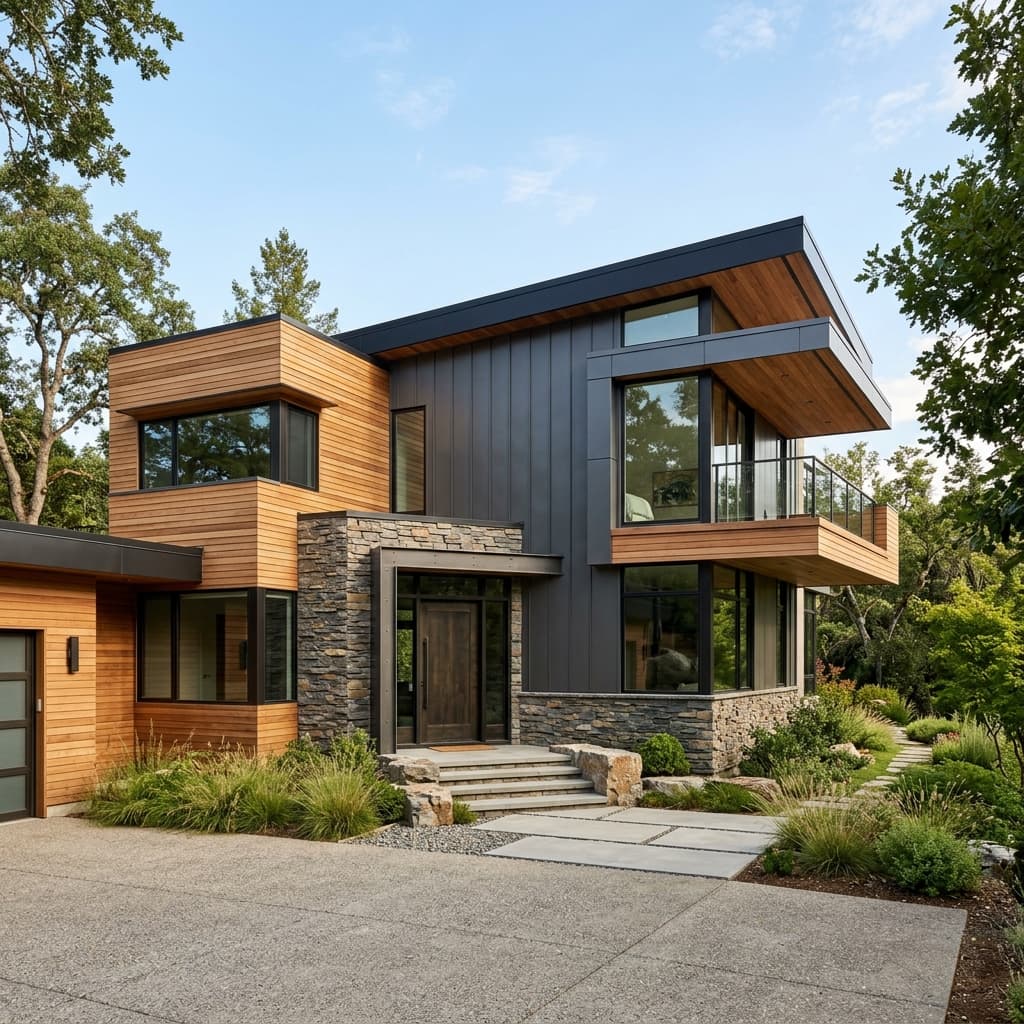
1. The Foundation (Wainscoting)
The most common and cost-effective application I recommend is a "water table" or wainscoting—adding stone to the bottom third of the house (typically up to the bottom of the first-floor windows). This grounds the home, covers up ugly exposed concrete foundations, and beautifully breaks up the monotony of continuous siding.
2. Porch Columns
Wrapping skinny, dated wooden porch posts in robust stone columns (often with thick craftsman-style wood pillars resting on top of the stone base) instantly transforms a basic entryway into a grand, sturdy entrance. This is a very popular upgrade I do on Craftsman and Bungalow style homes.
3. Accent Walls or Gables
Applying stone to a specific architectural feature, like a bump-out, a front-facing gable, or around a massive chimney, draws the eye and highlights the home's structure. My rule of thumb: only apply stone to elements that could structurally be made of solid stone in real life. Putting heavy stone on a second-story cantilevered bump-out over empty space looks structurally impossible and visually awkward.
Choosing the Right Stone Profile
Our visualizer lets you test different stone styles to match your home's architecture:
- Ledgestone (or Stacked Stone): Stacked, linear, and heavily textured with no visible mortar joints. Perfect for modern, contemporary, and transitional styles.
- Fieldstone: Random, organic shapes that look like they were naturally gathered from a field. Features wide mortar joints. Ideal for rustic, Tuscan, or traditional homes.
- Cut Cobblestone (or Ashlar): Clean, roughly rectangular blocks that offer a more formal, structured, and historic appearance.
See the Transformation
Don't buy pallets of expensive stone or hire a mason without knowing exactly how it will look next to your siding color.
Upload a photo of your home and use our AI to apply stone veneer wainscoting or column wraps. Play with warm, sandy tones versus cool, slate grays to find the perfect complementary palette for your existing paint color, ensuring you get the maximum return on your hardscaping investment!