By Mark Williams | Exterior Remodeling Expert
As a contractor who has renovated hundreds of front entryways, I can usually spot a DIY lighting job from the end of the driveway. The telltale sign is not the style of the light fixture itself. The giveaway is almost always the size.
Homeowners and amateur flippers consistently make the exact same mistake: they buy light fixtures that are drastically undersized for the home's architecture.
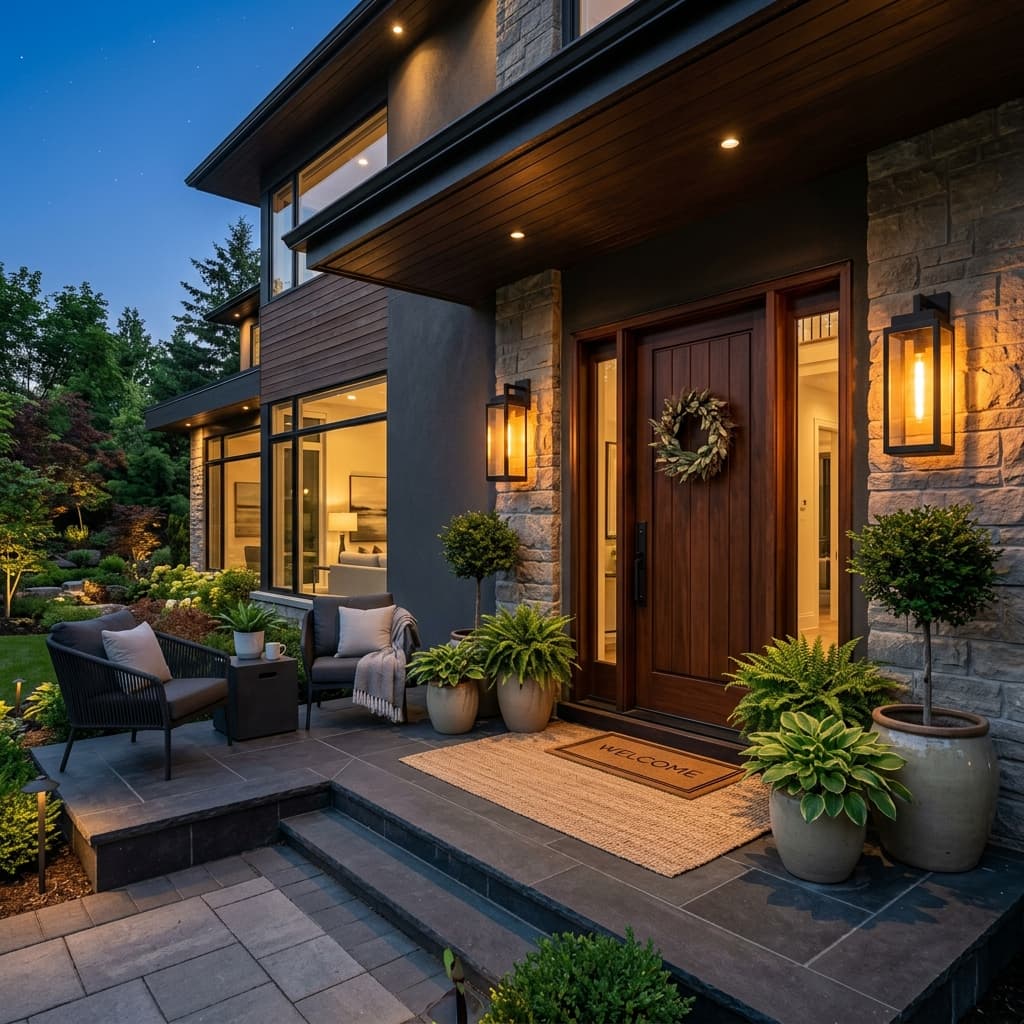
A tiny, six inch carriage light floating helplessly next to an eight foot tall solid wood entry door looks comical. It completely ruins the scale and grandeur of the entryway. In exterior design, scale is everything. If you are going to spend money upgrading your exterior lighting, you must follow the strict sizing and placement rules that professional architects use.
Here is my definitive guide to getting your front porch lighting exactly right.
1. The Rule of Proportions: How Big is Too Big?
When you look at a light fixture inside a brightly lit home improvement store, it looks massive. When you mount that exact same fixture on the massive exterior wall of your home, it visually shrinks by half.
You need to buy fixtures that feel uncomfortably large in the store. Here is the mathematical formula I use for every single project:
- One Light (Mounted on one side of the door): The fixture should be exactly one third the height of your front door. If you have a standard 80 inch (6 foot 8 inch) door, your single light fixture needs to be roughly 26 to 27 inches tall.
- Two Lights (Flanking both sides of the door): The fixtures should be exactly one quarter the height of your front door. For a standard 80 inch door, you need two fixtures that are 20 inches tall. If you have a massive 96 inch (8 foot) custom door, your flanking fixtures need to be at least 24 inches tall.
Do not cheat this rule. Oversized lighting looks luxurious and intentional. Undersized lighting looks cheap.
2. Placement and Mounting Height
Want to see this design on your house?
Don't just read about it. Upload a photo of your home and use our free AI visualizer to test these styles instantly.
Start Designing For FreeOnce you have the correct size, you have to mount them at the proper height. If you mount them too high, they cast harsh, unflattering shadows down onto your guests' faces. If you mount them too low, they blind people as they walk up the steps.
The Centerline Rule
The center of the light bulb (not the center of the metal fixture) should rest exactly at eye level. For the vast majority of homes, this means the center of the bulb should be roughly 66 inches (5.5 feet) from the floor of the porch.
- Adjusting for Stairs: If your guests have to walk up three steps to reach the porch landing, they will be looking up at the lights as they approach. In this scenario, you may need to drop the mounting height by a couple of inches to avoid blinding them from below.
3. Selecting the Right Color Temperature (Kelvin)
You can buy the most expensive, perfectly scaled copper lantern in the world, but if you put the wrong light bulb in it, your house will look terrible.
Light bulb "color temperature" is measured in Kelvin (K).
- Daylight Bulbs (5000K to 6000K): Never, under any circumstances, use "Daylight" or cool blue bulbs on your front porch. They belong in hospital operating rooms and commercial warehouses. They will make your house look sterile, uninviting, and ghostly.
- Warm White (2700K to 3000K): This is the sweet spot for exterior residential lighting. It provides a warm, welcoming, golden glow that enhances natural brick, stone, and wood tones. I personally prefer 2700K for a very traditional, cozy look, and 3000K for modern homes that need slightly crisper illumination.
4. Style Coordination
Your lighting must speak the same architectural language as the rest of your home.
- Modern Farmhouse: Go with sleek, matte black "gooseneck" barn lights or simple, oversized black lanterns with clear glass.
- Traditional or Colonial: Solid brass or copper onion lanterns and classic carriage lights are timeless. Let the brass naturally tarnish and patina over time for a high end, historic look.
- Mid-Century Modern: Look for cylindrical sconces or fixtures with geometric, atomic era shapes in dark bronze or brushed aluminum.
My Final Take
If you want to instantly increase your curb appeal in a single weekend, replace your front porch lights. It is one of the highest ROI projects you can tackle. Just remember the golden rules: buy fixtures that feel slightly too big in the store, mount them at eye level, and always use warm 2700K bulbs. By following these professional guidelines, your entryway will look incredibly custom, luxurious, and welcoming every time the sun goes down.