By Mark Williams | Exterior Remodeling Expert
Take a walk down the paint aisle of any big box home improvement store, and you will see stacks of cardboard boxes promising a shiny, professional grade garage floor for just a few hundred dollars. These DIY epoxy kits are incredibly tempting.
But as a contractor, I can tell you that the garage floor coating industry has a dirty little secret. Over 70 percent of the professional garage flooring jobs we do involve grinding off a failed, peeling DIY epoxy kit that the homeowner installed just one or two years prior.
If you are planning to coat your garage floor in 2026, you must understand the massive chemical difference between cheap, water based epoxy and professional grade polyaspartic coatings. Here is why I beg my clients to never buy a DIY epoxy kit.
1. The "Hot Tire Pick-Up" Phenomenon
The single biggest reason DIY epoxy kits fail is a phenomenon known as "hot tire pick-up."
When you drive your car on the highway during the summer, the rubber tires get incredibly hot. When you pull into your garage and park, that intense heat transfers directly into the epoxy coating beneath the tires. As the tires cool overnight, the rubber slightly contracts and grips the epoxy.
- The DIY Failure: Cheap DIY epoxy kits are typically water based and cure into a relatively soft, thin layer. When you back your car out of the garage the next morning, the hot tires literally rip chunks of the epoxy right off the concrete, leaving ugly, bare gray concrete patches where your tires used to sit.
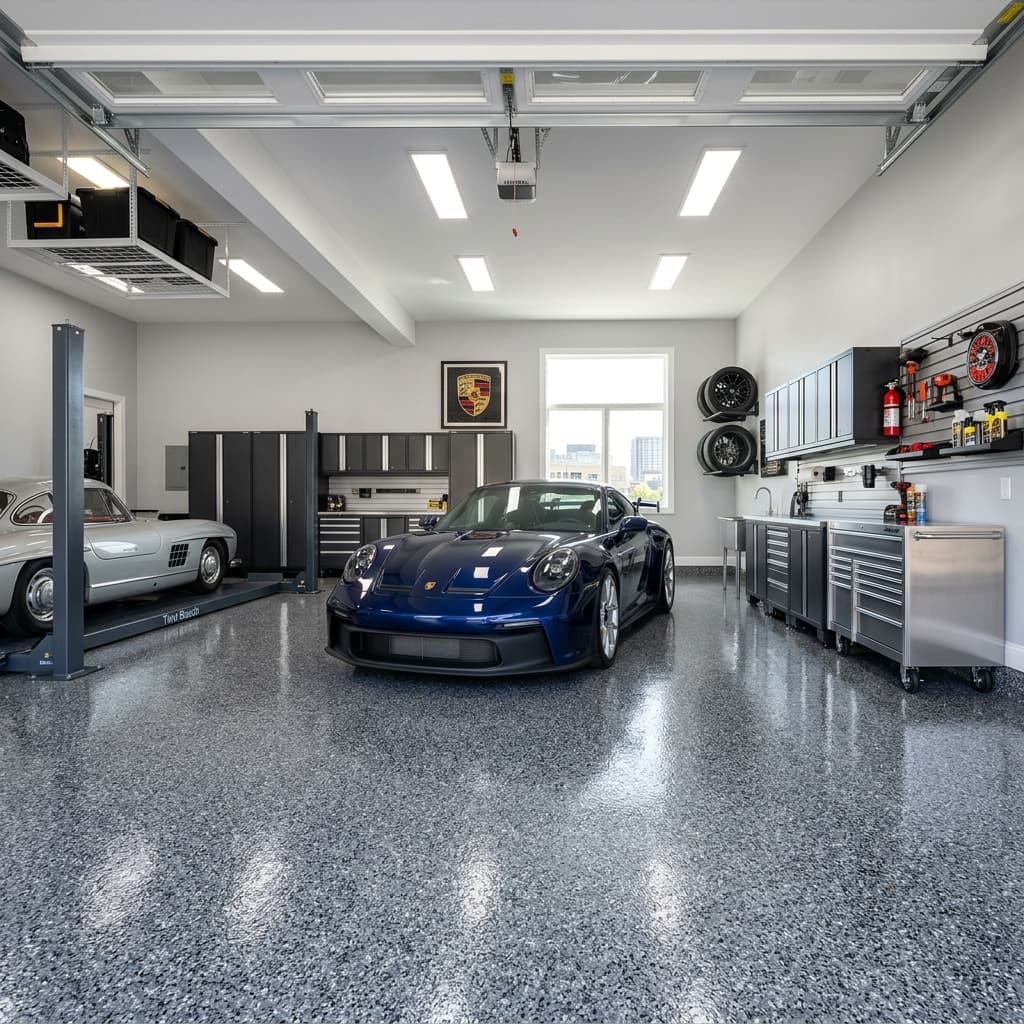
- The Professional Solution: Professional coatings (like polyaspartic or high solids polyurethane) cure into an incredibly dense, heat resistant shell that chemically bonds with the concrete. A professional coating will never peel up under hot tires.
Want to see this design on your house?
Don't just read about it. Upload a photo of your home and use our free AI visualizer to test these styles instantly.
Start Designing For Free2. The Preparation is the Entire Job
The instructions on a DIY epoxy kit usually tell you to sweep the floor and pour some diluted acid (muriatic acid) on the concrete to "etch" it before rolling out the paint.
This is a recipe for disaster.
Why Acid Etching Fails
Acid etching is a lazy, outdated preparation method. It does not remove deep oil stains, it does not open the pores of the concrete deeply enough, and it leaves behind a chalky residue if not perfectly neutralized. If the concrete is not perfectly prepared, the epoxy has nothing to grip, and it will eventually peel like a bad sunburn.
The Professional Method: Diamond Grinding
Professional installers do not use acid. They bring in massive, heavy duty planetary grinders equipped with industrial diamond blades.
- Grinding: The grinder literally shaves the top microscopic layer off the concrete, completely removing decades of oil stains, dirt, and sealers.
- Profiling: This process leaves the concrete with a rough, porous texture (similar to 60 grit sandpaper).
- Wicking: When the professional polyurea base coat is applied to this porous surface, it wicks deep down into the open capillaries of the concrete, creating a permanent, unbreakable mechanical bond.
3. Polyaspartic vs. Cheap Epoxy
In 2026, the absolute gold standard for garage floors is no longer traditional epoxy. It is a dual chemistry system utilizing a Polyurea base coat and a Polyaspartic clear top coat.
- UV Resistance: Traditional epoxy turns an ugly, amber yellow color when exposed to the UV rays from the sun shining through open garage doors. Polyaspartic top coats are 100 percent UV stable and will remain perfectly clear forever.
- Chemical Resistance: If you spill brake fluid, battery acid, or gasoline on a DIY epoxy floor, it will eat right through the coating. A polyaspartic floor is completely impervious to harsh automotive chemicals. You can literally wipe up a brake fluid spill with a paper towel, and the floor will look brand new.
- Cure Time: A DIY epoxy kit can take up to seven days to fully cure before you can park a car on it. A professional polyaspartic system cures so rapidly that you can park a 5,000 pound SUV on it just 24 hours after the installation is finished.
My Final Take
Your garage floor takes more abuse than any other surface in your entire home. It has to withstand thousands of pounds of rolling weight, hot rubber, chemical spills, and freezing road salt.
A $200 DIY epoxy kit is simply not chemically capable of surviving that environment. Do not waste your weekends grinding acid into your floor only to watch it peel up next summer. Hire a professional, ensure they use a diamond grinder for preparation, and insist on a polyaspartic top coat. It is a permanent, luxurious upgrade that you will only have to pay for once.