
Pathway Walkway Lighting
Explore the latest trends for pathway lighting ideas for front walkway. Find the perfect look for your home's architecture and discover complementary materials.
See this on your own home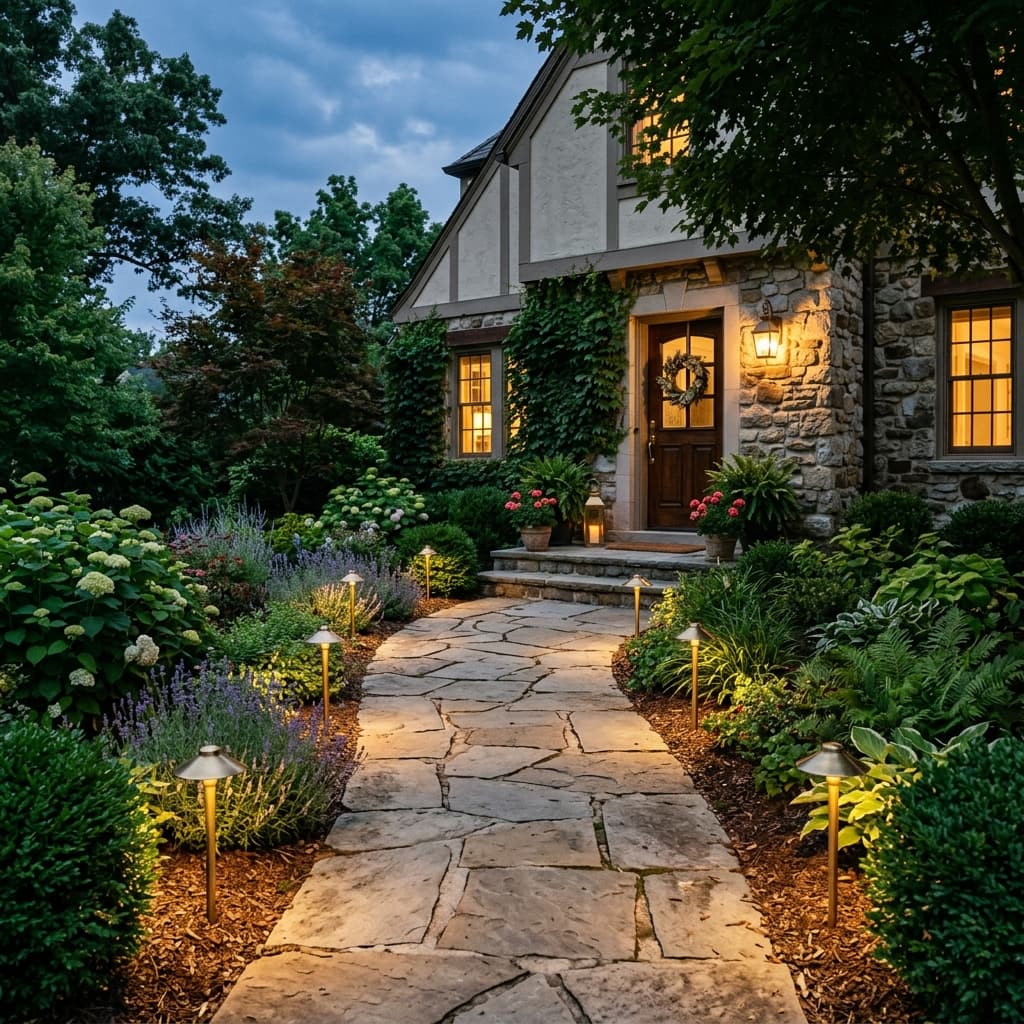
Design Considerations
What you need to know before choosing pathway walkway lighting.
Pros
- Crucial for guest safety at night
- Defines the edges of planting beds
- Invites people toward the front door
Cons & Challenges
- Easily kicked, bumped, or hit by lawnmowers
- Solar options are often dim and unreliable
- Requires careful spacing to avoid the "runway" look
Guiding the Way: Pathway and Front Walkway Lighting
A beautiful home with a dark, unlit front walkway is an architectural contradiction. It tells guests that the house is grand, but the journey to the front door is treacherous.
Pathway lighting is the crucial link between your driveway and your entryway. When executed properly, it ensures the safety of your guests, defines the boundaries of your expensive landscaping, and creates a highly inviting, resort-like atmosphere that draws the eye directly to the front door.
The "Airport Runway" Mistake
The single most common mistake homeowners make with pathway lighting is the "Airport Runway" effect.
This happens when a homeowner buys a box of 10 cheap solar lights and sticks them in the dirt in two perfectly straight, rigid lines exactly two feet apart down both sides of the walkway. It looks highly artificial, cluttered, and cheap.
The Professional Solution: Professional lighting designers use the principle of "staggering." Instead of two rigid lines, place the lights in a zigzag pattern, alternating from the left side of the path to the right side. Space them out generously (often 6 to 8 feet apart, depending on the brightness of the fixture). The goal is not to illuminate every single inch of the concrete, but to create gentle, overlapping pools of light that guide the eye naturally down the path.
Low-Voltage Wired vs. Solar
When shopping for pathway lights, you face a major technological choice: Solar or Low-Voltage Wired.
The Reality of Solar: Solar lights are incredibly easy to install (just stab them in the dirt) and cost nothing to operate. However, they are notoriously unreliable. If your walkway is shaded by trees or faces north, the solar panels will not charge adequately. By 9:00 PM, solar lights are often dim, and by midnight, they are completely dead. Furthermore, the plastic housings on cheap solar lights degrade and yellow rapidly in the sun.
The Superiority of Low-Voltage (12V) Wired: For a permanent, high-end look, you must invest in a hardwired, low-voltage landscape lighting system. A transformer is plugged into an exterior outlet, and a safe, low-voltage wire is buried an inch under the mulch, connecting all the fixtures.
- Reliability: Wired lights turn on at full brightness every single night, regardless of cloud cover, and stay on until dawn.
- Quality: Low-voltage fixtures are typically made of heavy cast brass or powder-coated aluminum, designed to withstand rogue lawnmowers and decades of harsh weather without degrading.
Choosing the Right Fixture Style
The style of the path light should echo the architecture of the home.
- For Traditional Homes: Choose the classic "hat" or "mushroom" style fixture. A solid metal dome hides the bulb completely from the eye, reflecting the light softly downward onto the path.
- For Modern Homes: Choose sleek, architectural bollards. These are solid, vertical pillars of metal (often square or cylindrical) with precise slits or cutouts that cast sharp, geometric beams of light onto the walkway.
Frequently Asked Questions
Common questions about pathway walkway lighting and exterior visualization.
How can I see what my house looks like with pathway walkway lighting?
You don't have to guess based on small samples. You can use Exterior Vibe's free AI visualizer to upload a photo of your house and instantly see pathway walkway lighting applied to your exterior in seconds.
Is there an app to test outdoor lighting on my home exterior?
Yes, Exterior Vibe is a free web application that allows you to test different outdoor lighting options on your actual home. Simply upload a photo and the AI will apply the new materials, taking lighting and rooflines into account.